
You’ve felt it. A conversation flows perfectly for days. You share things you rarely tell anyone. Then you meet in person and something feels off. That gap between digital warmth and real-world distance is exactly how dating apps create false intimacy, and it’s not a personal failure. It’s a feature of the technology itself. The psychological term for this is the hyperpersonal effect, and once you understand how it works, you’ll never read a “good morning” text the same way again.
Table of Contents
-
How dating apps create false intimacy through hyperpersonal communication
-
Practical ways to protect yourself from virtual intimacy pitfalls
Key takeaways
| Point | Details |
|---|---|
| Hyperpersonal effect drives false closeness | Edited self-presentation and idealized perception accelerate perceived intimacy far faster than real-world interaction. |
| Burnout erodes genuine connection | Communication overload and endless swiping exhaust users, pushing them toward shallow, low-investment behavior. |
| Stress gets mistaken for chemistry | Nervous system threat responses triggered by uncertainty mimic the feeling of passion or deep connection. |
| Disclosure online is fragile | Rapid, reversible sharing on apps does not build the mutual trust that face-to-face interaction creates. |
| Intentional habits protect you | Limiting swipe time, prioritizing consistency over intensity, and moving offline faster all support real closeness. |
How dating apps create false intimacy through hyperpersonal communication
The hyperpersonal model, developed by communication researcher Joseph Walther, explains why online intimacy intensifies faster than face-to-face connection. On dating apps, you control every word. You reread, edit, and delete before sending. That level of curation is impossible in person, and it produces something that feels like closeness but is actually a polished performance.
Here’s what happens on both sides of the screen:
-
Selective self-presentation: You share your best stories, your sharpest humor, and your most thoughtful observations. The awkward pauses, the nervous habits, the contradictions, none of those make it through.
-
Idealized perception: The person reading your messages fills in every gap with their imagination. Because they have limited cues, they tend to construct an ideal version of you.
-
Accelerated disclosure: The low-stakes, low-accountability environment of an app makes it easier to share personal things quickly. That rapid sharing feels like trust being built.
-
Intensity without stability: The intimacy built online can feel more intense than anything you’ve experienced in person. But it’s built on inference and editing, not on mutual, observed behavior.
The result is a connection that feels real and deep because, emotionally, it is real to you. The problem is that it’s built on a curated version of two people, not the actual ones.
Pro Tip: Before you decide you have chemistry with someone online, ask yourself: have you seen how they handle frustration, boredom, or a bad day? If the answer is no, what you’re feeling is possibility, not closeness.
The emotional cost of burnout on dating apps
Dating app burnout is not just feeling tired of swiping. It’s a recognized pattern of emotional exhaustion, cynicism, and a reduced sense of personal effectiveness in dating. Burnout symptoms are common across app users, and they quietly reshape how you engage with everyone you meet online.
A 2026 study using the Stressor-Strain-Outcome framework identified three core stressors driving this exhaustion:
| Stressor | What it looks like | Emotional impact |
|---|---|---|
| Communication overload | Juggling multiple conversations at once | Shallow, copy-paste responses |
| Information overload | Scrolling through profiles that blur together | Decision fatigue, reduced care |
| Technological vulnerabilities | Ghosting, unmatching, app glitches | Distrust, emotional withdrawal |
Each of these stressors degrades meaningful engagement over time. What starts as genuine curiosity about each new person slowly becomes a mechanical process. You stop seeing people as individuals and start processing them as options.
The BBC’s reporting on this phenomenon captures it well: users describe dating apps as exhausting, comparing the volume of interactions to holding down a second full-time job. When you’re that depleted, genuine intimacy requires more energy than you have left to give.
Pro Tip: If you notice you’re responding to messages on autopilot or feeling nothing when someone new matches with you, that’s burnout talking. Take a week off the apps entirely before re-engaging.
When stress gets mistaken for chemistry
This is the part that surprises most people. The nervous system does not distinguish well between excitement and threat. When someone goes quiet for two days, when you’re waiting on a reply, when a conversation suddenly cools, your body registers that as danger. And modern dating industrializes that uncertainty, making it a near-constant experience.
Here’s what that cycle actually looks like:
-
You have an intense conversation. You feel seen, warm, close.
-
They go quiet. Your nervous system activates. You check your phone repeatedly.
-
They respond. Relief floods through you. The warmth returns, amplified.
-
You interpret that relief as passion. As chemistry. As proof of connection.
What you’re actually experiencing is an intermittent reinforcement pattern. It’s the same mechanism behind slot machines. The unpredictable reward creates obsessive engagement, not genuine bonding. Your attachment system fires in response to threat, not in response to safety.
This matters especially if you have an anxious attachment style. The hot-and-cold behavior common on dating apps doesn’t just feel uncomfortable. It actively reinforces anxious patterns, making it harder to recognize what secure, steady connection actually feels like. A relationship that feels calm and consistent can seem boring by comparison, even when it’s the healthier one.
Why online disclosure doesn’t build real trust
Sharing something personal with someone online feels vulnerable. It is vulnerable, in a sense. But the conditions that make offline disclosure meaningful are largely absent on apps.
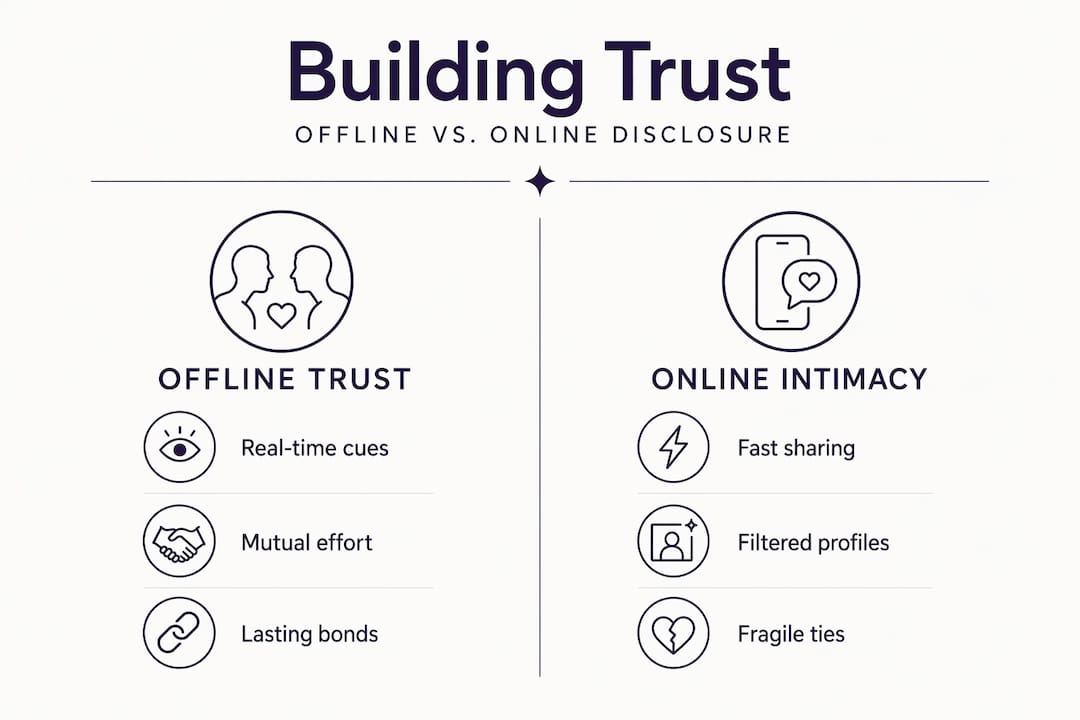
In person, when you tell someone something private, you’re reading their face. You’re watching their body language. You’re experiencing mutual risk in real time. That shared vulnerability is what builds trust. Online, you’re sending words into a void and hoping for the best.
| Offline disclosure | Online disclosure |
|---|---|
| Mutual, observed in real time | Often one-sided and asynchronous |
| Irreversible and witnessed | Easily reversed: block, unmatch, delete |
| Builds accountability | Carries little to no accountability |
| Grounded in embodied cues | Based on edited text and inference |
The fragility shows up fast. You’ve had a week of intense sharing with someone. Then they unmatch. The emotional mismatch when transitioning offline is jarring precisely because you built closeness on inference rather than mutual behavior. You thought you knew them. You knew their edited version.
This dynamic also encourages a “keep options open” mentality. When intimacy signals are cheap and easily reversible, users favor low-investment interactions over relational depth. Why invest fully in one person when the next conversation is one swipe away? This especially matters for men who identify as Sides, shortstops, gay, bi, or no-label — men who want connection without being forced into traditional dating scripts. SideFocus was created for men who are tired of being misunderstood, rushed, or reduced to one kind of expectation. Here, connection can move with more honesty, more patience, and more room to be seen.
Practical ways to protect yourself from virtual intimacy pitfalls
Recognizing the trap is the first step. Getting out of it takes deliberate practice. Here’s what actually works:
-
Cap your daily swipe time. Thirty minutes is enough. More than that and you’re feeding overload, not finding connection. Scarcity of attention makes each conversation more meaningful.
-
Prioritize consistency over intensity. Someone who texts you every day at a moderate, steady pace is showing you more about their character than someone who floods your inbox for three days and then vanishes.
-
Move to a video call or in-person meeting within two weeks. Embodied interaction introduces the cues that apps strip away. You’ll know within one real conversation whether the connection holds.
-
Learn to distinguish stress from warmth. Ask yourself: do I feel safe with this person, or do I feel activated? Warmth is calm. Stress is electric. They are not the same thing.
-
Set a limit on how many conversations you run simultaneously. Three is a reasonable ceiling. More than that and you’re processing people, not connecting with them.
Pro Tip: When you notice yourself obsessively checking your phone for a reply, pause and name what you’re feeling. That awareness alone interrupts the anxious cycle and helps you respond from a grounded place instead of a reactive one.
My take on why this matters more than most people admit
I’ve spent a long time thinking about why so many people feel lonelier after years on dating apps than they did before they started. The honest answer is that the apps are very good at simulating the early feelings of connection while quietly removing the conditions that make those feelings last.
What I’ve found is that most people don’t realize they’ve been in a false intimacy loop until they’ve experienced something genuinely different. The contrast is striking. A relationship built on presence, consistency, and real-world care feels almost slow by comparison to the dopamine rush of app interactions. But that slowness is exactly what makes it stable.
The uncomfortable truth I’ve had to sit with is this: anxious, electric, uncertain connection feels more like love to many of us because that’s what we’ve been trained to recognize. Calm, secure, present connection can feel unfamiliar at first. That doesn’t make it less real. It makes it more worth pursuing.
The emotional complexities of app-based dating are real and they deserve honest conversation. Not judgment. Just clarity.
— KEITHEN
A different kind of room exists for you
If any of this resonates, you’re not broken and you’re not alone. The patterns described here are the predictable result of platforms designed for volume, not closeness.

Sidefocusapp was built with a different intention entirely. It’s a space designed specifically for men who want warmth, presence, and genuine care without the performance that most apps demand. There’s no endless swiping, no inbox overload, no hot-and-cold games. Just real connection, no install needed. The room is small on purpose. The people inside it are looking for the same thing you are. If you’re ready to step away from the noise and into something that actually feels like closeness, Sidefocusapp is where that starts.
FAQ
What does false intimacy in dating mean?
False intimacy in dating refers to a perceived sense of closeness that lacks the stability, mutual accountability, and embodied experience of genuine connection. It often develops through edited, curated communication rather than real-world interaction.
Why do dating app conversations feel so intense?
The hyperpersonal effect causes online conversations to accelerate perceived intimacy because users present idealized versions of themselves and recipients fill in gaps with imagination, creating a closeness that feels deep but is built on inference.
Can dating app burnout affect real relationships?
Yes. Emotional exhaustion from apps reduces your capacity for relational effort, promotes cynicism, and encourages low-investment behavior that carries over into how you engage with people offline.
How do I know if I’m feeling chemistry or just stress?
Chemistry rooted in secure connection feels calm and safe. Stress-driven attraction feels electric and anxious. If you’re obsessively checking your phone or replaying conversations, that’s your nervous system responding to threat, not your heart recognizing a match.
Does moving offline faster actually help?
It does. In-person or video interaction reintroduces the embodied cues that apps remove, giving you a much more accurate read on whether the connection is real or whether it was built on edited text and idealized inference.