
Care-based dating is the relationship approach that prioritizes genuine attentiveness, appreciation, and emotional support between partners to create deeply fulfilling connections. Unlike chemistry-driven or casual dating, this style meets multiple fundamental human needs at once, which research consistently links to higher satisfaction and long-term commitment. A 2026 study published in Psychology Today identified "Here-for-You" relationships as the most common and most satisfying relationship type, covering caregiving, security, emotional intimacy, and independence simultaneously. Understanding why care-based dating is fulfilling means looking at the psychology behind how people feel loved, not just how love is given.
Why care-based dating is fulfilling compared to other relationship types
Research from Kong et al. published in 2026 identified five distinct relationship types based on how well they fulfill foundational human needs. The findings are striking. Not all relationship styles are equal in what they deliver emotionally, and the differences in satisfaction are significant.
The five types range from relationships focused primarily on personal growth or independence to those offering broad, multi-need support. "Here-for-You" relationships sit at the top. They fulfill multiple needs including caregiving, safety, emotional intimacy, and independence, and they represent roughly 37% to 47% of all relationships studied. That breadth of fulfillment is what separates them from narrower styles.
"Solid Support" and "Personal Growth" relationships also show decent satisfaction scores, but they tend to cover fewer emotional domains. A relationship built primarily around shared ambition, for example, may feel exciting early on but leave partners feeling unseen or unsupported when life gets hard. Care-based dating avoids that gap by keeping warmth and presence at the center.
| Relationship type | Needs fulfilled | Satisfaction level |
|---|---|---|
| Here-for-You | Caregiving, safety, intimacy, independence | Highest |
| Solid Support | Caregiving, safety, companionship | High |
| Personal Growth | Independence, growth, stimulation | Moderate |
| Passion-Focused | Physical intimacy, excitement | Lower long-term |
| Minimal Fulfillment | Few needs met | Lowest |
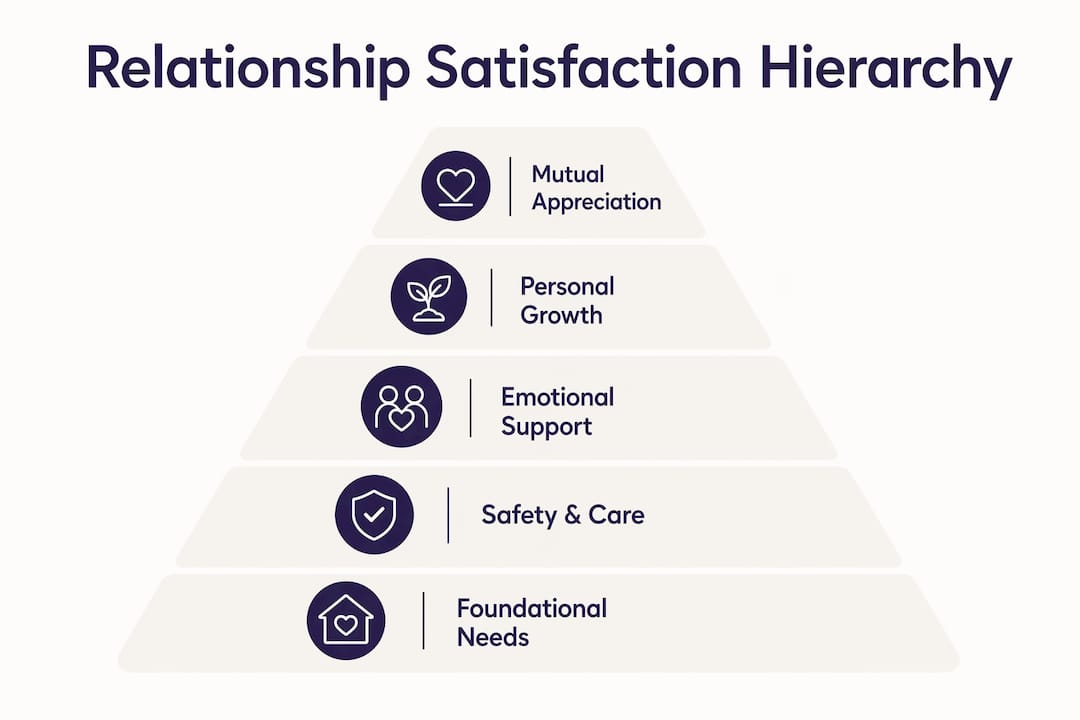
The table above makes the pattern clear. The more foundational needs a relationship covers, the more fulfilling it becomes over time. Care-based dating is not a soft or secondary preference. It is the structure most likely to sustain genuine closeness.
How feeling cared for drives relationship satisfaction
Here is something most people get wrong: caring deeply for your partner does not automatically make them feel loved. A 2026 study in Frontiers in Psychology found that feeling loved predicts relationship satisfaction more strongly than being loving. Only the perception of a partner's behavior, not one's own self-reported loving behavior, uniquely predicted satisfaction in logistic models. This means your partner's experience of your care matters more than your intention to give it.
This distinction changes everything about how to approach a relationship. You can be deeply devoted and still leave your partner feeling emotionally distant if your care is not expressed in ways they can clearly read. Warmth needs to be visible, interpretable, and consistent.
Attachment dynamics play a major role here. A 2026 study in Frontiers in Psychiatry found that insecure attachment predicts lower relationship satisfaction through reduced appreciation expression and perceived giving, with chain mediation effects of -0.17 for attachment avoidance and -0.07 for attachment anxiety. This means people who struggle to express or receive care are caught in a cycle where less appreciation leads to less giving, which leads to less satisfaction. Care-based dating, with its emphasis on explicit and consistent warmth, directly interrupts that cycle.
- Express appreciation in specific, named ways. "I noticed you checked in on me today" lands differently than a generic "thank you."
- Respond to bids for connection, even small ones. A text replied to, a look acknowledged, a worry taken seriously.
- Make care visible through behavior, not just feeling. Presence, attention, and follow-through are the signals that register.
Pro Tip: The most common misconception in dating is that good intentions create felt closeness. They do not. Clear, warm, easy-to-read signals of care are what your partner actually experiences. Audit your behavior, not just your feelings.
Why attentiveness and emotional support create lasting bonds
Attentiveness is not a soft skill. It is a causal mechanism. A 2026 study published in ScienceDirect found that relational care mediated by attentiveness has a transformative impact on health and well-being. Care does not just feel good. It produces measurable outcomes in how safe, stable, and connected people feel within a relationship.
The reason attentiveness works so deeply is that it generates what researchers describe as micro-experiences of felt safety. Every time a partner notices your mood, remembers a detail you shared, or responds to your emotional state without being prompted, it sends a signal: you matter here. These moments are small individually, but they build long-term bond strength through repetition. Security is not built in grand gestures. It is built in the accumulation of ordinary moments where someone showed up.
This is why care-based dating tends to outlast chemistry-driven relationships. Passion fades. Attentiveness, practiced consistently, creates a foundation that does not.
Here are practical ways to cultivate attentiveness in dating:
- Put your phone down during conversations. Full presence is rare and noticed.
- Ask follow-up questions about things your partner mentioned days ago. It signals that you were actually listening.
- Name what you observe. "You seem quieter today" opens more than silence does.
- Respond to emotional content, not just the surface of what is said.
- Create small rituals of connection, a morning check-in, a shared end-of-day moment, that signal reliability.
Pro Tip: Attentiveness is not about being perfect. It is about being consistent. One genuine moment of presence per day does more for a relationship than a grand romantic gesture once a month.
What AI companions reveal about the importance of care in dating
The rise of AI companions has offered an unexpected mirror for understanding why care-based dating is fulfilling. A Harvard Business School study referenced by the APA in 2026 found that AI companions reduce loneliness comparably to human interaction, primarily by making users feel heard and respected. That finding is striking. It confirms that the emotional impact of care is real and measurable, even when the source is artificial.
What AI gets right is the simulation of attentiveness. It responds. It remembers. It does not judge. For people who have rarely experienced that in human relationships, the effect can feel profound. But the same research cautions that care gestures can be misinterpreted when they lack genuine warmth, reciprocity, or the capacity for real vulnerability. AI can simulate presence. It cannot offer it.
| Care indicator | Human relationship | AI companionship |
|---|---|---|
| Feeling heard | Deep, reciprocal | Simulated, one-directional |
| Emotional attunement | Grows over time | Static, pattern-based |
| Vulnerability and risk | Present, meaningful | Absent |
| Loneliness reduction | Sustained | Short-term relief |
| Long-term bond formation | Yes | No evidence |
The lesson for real-life dating is direct. The qualities that make AI companions temporarily comforting, attentiveness, responsiveness, and non-judgment, are exactly what care-based dating delivers in a human context. The difference is that human care carries weight, history, and genuine stakes. That is what makes it irreplaceable.
Key takeaways
Care-based dating is fulfilling because it meets multiple foundational human needs through perceived attentiveness, appreciation, and emotional presence, which research links directly to higher satisfaction and lasting commitment.
| Point | Details |
|---|---|
| Perception over intention | Feeling loved predicts satisfaction more than being loving; care must be visible and readable. |
| Multi-need fulfillment | "Here-for-You" relationships covering caregiving, safety, and intimacy score highest in satisfaction. |
| Attentiveness as mechanism | Relational care mediated by attentiveness causally improves well-being and bond strength. |
| Attachment cycles | Insecure attachment reduces appreciation expression, lowering satisfaction; care-based dating interrupts this cycle. |
| AI as a mirror | AI companions confirm care's emotional power while showing that human warmth and reciprocity remain irreplaceable. |
What I've learned about care-based dating that most articles miss
Most conversations about meaningful relationships focus on compatibility or communication. Those matter. But after spending years observing how people actually connect and disconnect, the clearest pattern I see is this: the relationships that last are the ones where both people feel consistently noticed.
Not celebrated. Not swept off their feet. Just noticed. Seen in the ordinary moments. That is the core of care-based dating, and it is harder to practice than it sounds because it requires showing up when there is nothing dramatic to respond to.
I have also seen how much care-based dating benefits people who carry attachment insecurities. The research backs this up. Appreciation cycles created by consistent, warm behavior directly counter the avoidance and anxiety patterns that otherwise erode satisfaction. For anyone who has felt like closeness is always slightly out of reach, a care-centered partner does not just feel good. It rewires what feels possible.
The dating culture is shifting. More people are screening for emotional safety early, asking not just "are we attracted to each other?" but "do I feel safe being honest with you?" That is the right question. And it is the question care-based dating is built to answer.
— Albert
Find your people at Sidefocusapp

At Sidefocusapp, we built something specific on purpose. This is a space for men who identify as Sides, those who want genuine closeness, warmth, and presence without the pressure of traditional roles or performative dating. Every feature here, from unlimited messaging to a community that actually talks, is designed around one idea: that real connection starts with feeling cared for and heard. No app store. No gatekeeping. Just a room where the right kind of intimacy is already the norm. If that sounds like what you have been looking for, come find your place with us.
FAQ
What is care-based dating?
Care-based dating is a relationship approach centered on attentiveness, appreciation, and emotional support rather than chemistry or physical attraction alone. It prioritizes partners genuinely feeling cared for, which research links to higher satisfaction and long-term commitment.
Why does feeling loved matter more than being loving?
A 2026 Frontiers in Psychology study found that perceiving your partner's loving behavior predicts relationship satisfaction more strongly than your own self-reported loving behavior. Your partner's experience of your care is what drives fulfillment, not your intention behind it.
How does attachment style affect care-based dating?
Insecure attachment reduces appreciation expression and perceived giving, which lowers relationship satisfaction through a measurable chain mediation effect. Care-based dating, with its emphasis on consistent and visible warmth, directly counters these patterns and benefits people with attachment insecurities most.
Can attentiveness really build a lasting bond?
Yes. A 2026 ScienceDirect study found that relational care mediated by attentiveness causally improves health and well-being outcomes. Repeated micro-moments of felt safety and mattering accumulate into the kind of security that sustains long-term relationships.
What makes care-based relationships different from passion-focused ones?
Passion-focused relationships fulfill fewer foundational needs and show lower long-term satisfaction in research. Care-based relationships cover caregiving, safety, emotional intimacy, and independence simultaneously, which is the combination most strongly associated with lasting fulfillment.