
Closeness-focused dating is a relationship approach that centers on building emotional intimacy and a sense of safety before pursuing romance or physical connection. It is the recognized alternative to speed-driven or hookup-oriented dating, and it draws on concepts like friendship-first dynamics, emotional availability, and genuine vulnerability. The Gottman Institute describes this as creating a "felt safe" relationship culture where both people feel deeply known before anything else accelerates. If you have ever wanted warmth before heat, presence before performance, this approach was built for you.
What is closeness-focused dating, really?
Closeness-focused dating is defined as the intentional practice of prioritizing emotional intimacy, trust, and mutual safety as the foundation of a romantic relationship, rather than physical chemistry or relationship milestones. The standard industry term for this broader orientation is emotional intimacy dating, though closeness-focused dating captures the deliberate pacing and relational care that sets it apart.
This approach includes what researchers and therapists call friendship-first dynamics, where communication, respect, and personal autonomy come before romantic escalation. It also draws on the concept of vulnerability as a shared, gradual process rather than a performance. You are not rushing toward a label or a milestone. You are building something that can actually hold weight.

The importance of closeness in relationships is not a soft or secondary concern. It is the structural foundation that determines whether a relationship survives real life. Without it, even the most exciting early chemistry tends to collapse under the pressure of conflict, change, or time.
What emotional intimacy actually means in dating
Emotional intimacy is a physiological state, not just a feeling. Genuine intimacy shifts the nervous system from a state of protection to one of connection, which is why it enables deeper bonding than conversation alone can produce. You feel it in your body: a relaxed presence, an absence of the need to perform or protect yourself.
The Gottman Institute identifies emotional intelligence as the core skill required to build this kind of intimacy. That means managing your own emotional responses and attuning to what your partner is experiencing, often without them saying it directly. Both capacities matter equally.
Emotional intimacy is also distinct from intellectual connection or physical attraction, though it can coexist with both. Consider the difference:
- Intellectual connection is the pleasure of shared ideas and stimulating conversation.
- Physical attraction is the pull of chemistry and presence.
- Emotional intimacy is the experience of feeling fully known, safe, and supported by another person, without needing to edit yourself.
"Intimacy allows partners to be fully themselves early on, which is the foundation of lasting relationship satisfaction." — Verywell Mind
That last distinction matters most for closeness-oriented relationships. You can have great conversations with someone and still feel unseen. Emotional intimacy is what closes that gap.
How closeness-focused dating differs from traditional and hookup-oriented dating
The contrast is clearest when you look at pacing and focus. Hookup culture and conventional dating often treat early connection as a funnel: physical attraction leads to dates, dates lead to escalation, and emotional depth is either assumed or skipped. Closeness-focused dating inverts that sequence entirely.
| Dimension | Hookup-oriented dating | Closeness-focused dating |
|---|---|---|
| Primary focus | Physical chemistry | Emotional safety and presence |
| Pacing | Fast escalation | Gradual, intentional progression |
| Vulnerability | Rare or performed | Genuine and reciprocal |
| Success metric | Physical outcome | Feeling known and cared for |
| Foundation | Attraction | Trust and communication |
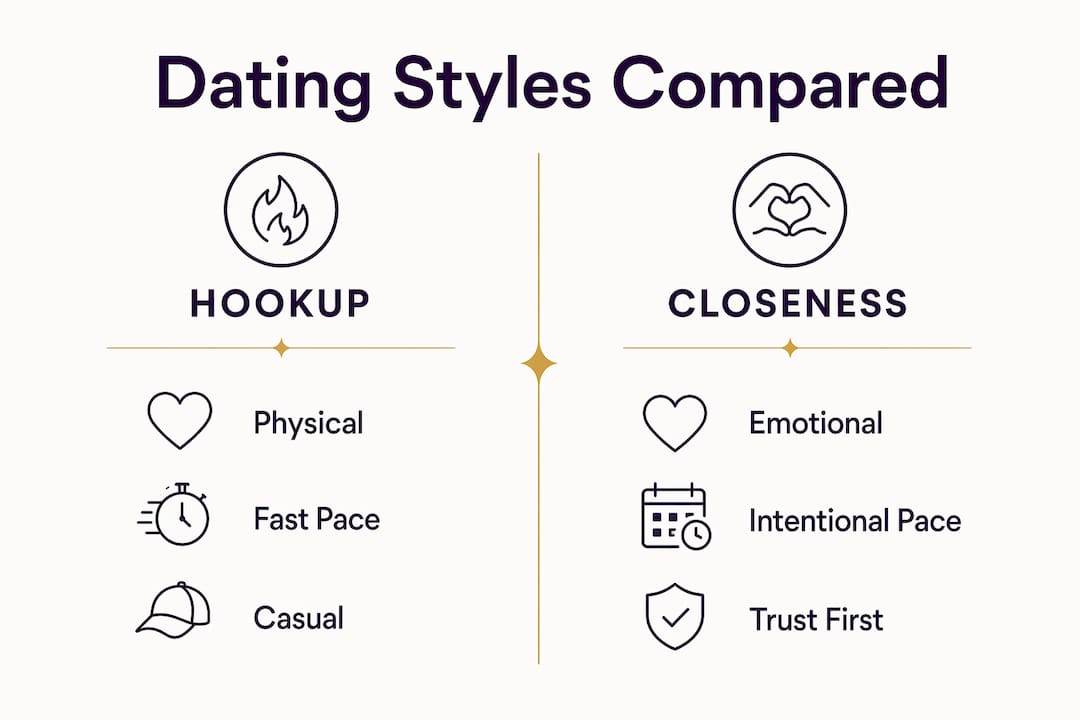
Hookup culture dominates many mainstream dating apps in 2026, which is exactly why closeness-focused dating feels countercultural. It asks you to slow down in an environment designed for speed.
One common misconception is that closeness-focused dating means intensity. It does not. Intensity can actually work against genuine intimacy. When two people rush into deep emotional disclosure too quickly, it can feel destabilizing rather than connecting. Real closeness builds through consistent, low-pressure interactions over time.
The data supports the preference for this approach. 47% of people prefer starting romantic relationships with a friendship-first approach, and 68% report that their most meaningful relationships began that way. These numbers reflect a genuine human preference that mainstream dating culture has largely ignored.
Pro Tip: If you are exploring closeness-focused dating for the first time, try measuring early dates not by how exciting they felt, but by how safe and at ease you felt. That shift in metric changes everything.
How to build intimacy in dating: key behaviors that actually work
Building closeness in early dating is a practice, not a personality trait. These are the behaviors that create the conditions for genuine emotional intimacy to develop.
-
Create a holding environment. Steadiness and responsiveness are the two pillars of what therapists call emotional holding. This means showing up consistently, following through on small commitments, and responding directly when someone shares something vulnerable. You do not need grand gestures. You need reliability.
-
Practice intentional listening. Most people listen to respond. Intentional listening means staying fully present with what the other person is saying, noticing the emotion underneath the words, and reflecting it back. "That sounds like it was really hard" lands differently than "Yeah, I get it."
-
Name your emotional availability clearly. Ambiguity is the enemy of closeness. If you are going through something difficult, say so. If you are genuinely interested, say that too. Clear communication about your capacity and your feelings removes the anxiety that prevents people from opening up.
-
Use curiosity as a tool. The Gottman Institute's research on deepening emotional intimacy shows that asking thoughtful, open-ended questions signals genuine interest and creates the conditions for vulnerability. Questions like "What does that mean to you?" or "How did that shape the way you see things now?" go far deeper than surface-level small talk.
-
Respect autonomy throughout. Closeness does not mean merging. Friendship-first dating works precisely because it honors each person's separateness while building connection. Pushing for more closeness than someone is ready for creates the opposite of intimacy: it creates pressure.
-
Name the transition explicitly. When a friendship begins shifting toward romance, naming that dynamic directly reduces confusion and protects the emotional safety you have already built. Clarity is an act of care.
Pro Tip: Emotional availability is not the same as emotional intensity. You can be calm, steady, and fully present. That combination is more attractive and more connecting than any dramatic display of feeling.
Common challenges in closeness-focused dating and how to navigate them
Even when you are committed to this approach, real obstacles show up. Knowing them in advance makes them easier to move through.
-
Anxiety-driven closeness versus genuine intimacy. Closeness can be anxiety-driven, seeking reassurance and predictability rather than real connection. Genuine intimacy requires curiosity and the ability to tolerate some separateness without panic. If you notice yourself needing constant contact or reassurance, that is worth examining honestly.
-
Performing vulnerability. Talking about deep topics is not the same as being emotionally open. Performing vulnerability without the physiological safety signals, like relaxed presence and genuine attentiveness, produces the appearance of intimacy without the substance. Authenticity cannot be scripted.
-
Mixed or inconsistent signals. Inconsistency creates anxiety, and anxiety shuts down the nervous system's capacity for connection. If you are receiving mixed signals, naming the pattern directly is more effective than tolerating it. "I notice things feel uncertain between us. Can we talk about where we both are?" is a sentence that protects closeness rather than threatening it.
-
Confusing closeness with romance. Closeness and intimacy are related but not identical. Intimacy requires both connection and separateness, curiosity and risk. Closeness alone can feel safe and warm without ever becoming romantic. Being honest with yourself about which one you are experiencing, and which one you want, prevents a lot of confusion.
-
Pacing pressure from outside. Friends, family, and dating culture all carry implicit timelines. Closeness-focused dating asks you to set your own pace. That takes confidence, especially when the people around you are moving faster.
Key takeaways
Closeness-focused dating works because it builds emotional safety first, which is the only foundation on which genuine intimacy, lasting attraction, and real trust can grow.
| Point | Details |
|---|---|
| Emotional safety comes first | Closeness-focused dating prioritizes feeling known and safe before romance or physical connection advances. |
| Friendship-first is widely preferred | 47% of people prefer a friendship-first start, and 68% report their best relationships began that way. |
| Intimacy is physiological, not just verbal | Genuine emotional intimacy shifts the nervous system to connection; it cannot be performed or rushed. |
| Consistency builds closeness | Steadiness, responsiveness, and clear communication are the practical behaviors that create a holding environment. |
| Name transitions explicitly | Moving from friendship to romance requires direct conversation to protect emotional safety and reduce confusion. |
What I have learned from watching people practice this
Albert's take:
The most common mistake I see is treating closeness-focused dating as a slower version of conventional dating. It is not. It is a fundamentally different orientation. The goal is not to delay romance. The goal is to build something real enough that romance, when it arrives, actually means something.
What surprises people most is how much patience this requires from themselves, not just from the other person. We are conditioned to read speed as interest and slowness as rejection. Unlearning that takes real self-awareness. The men I have seen thrive with this approach are not the ones who are naturally patient. They are the ones who got honest about what they actually wanted: warmth, care, presence, and the feeling of belonging somewhere specific.
Emotional safety is not a soft goal. It is the hardest thing to build and the most valuable thing a relationship can offer. Resist the cultural pressure to perform chemistry or manufacture depth. Show up steadily. Ask real questions. Let yourself be known gradually. That is not a compromise. That is the whole point.
— Albert
Find your people on Sidefocusapp

If closeness-focused dating resonates with you, you deserve a space built for exactly that. Sidefocusapp is designed for men who want genuine warmth and care over performance or speed. The platform prioritizes authentic online connections through unlimited messaging and community engagement, without the pressure of app store installs or hookup-first defaults. The door is small on purpose. It opens into a room where presence matters more than profile polish. If you are ready to explore dating for emotional connection in a space that actually gets it, start here at Sidefocusapp.
FAQ
What is closeness-focused dating in simple terms?
Closeness-focused dating is the practice of building emotional intimacy, trust, and safety as the foundation of a relationship before advancing physically or romantically. It draws on friendship-first dynamics and genuine vulnerability rather than speed or chemistry.
How is emotional intimacy different from physical attraction?
Emotional intimacy is the experience of feeling fully known, safe, and supported by another person. Physical attraction is the pull of chemistry and presence. The two can coexist, but emotional intimacy is what sustains a relationship over time.
Is closeness-focused dating the same as a slow-burn relationship?
Not exactly. A slow-burn relationship describes pacing. Closeness-focused dating describes intention. The focus is on building emotional safety and genuine connection, not simply delaying physical or romantic escalation.
How do you build emotional closeness early in dating?
Emotional closeness builds through consistent presence, intentional listening, clear communication about feelings and availability, and responding directly to moments of vulnerability. Reliability matters more than grand gestures.
Can closeness-focused dating work on dating apps?
Yes, but it requires choosing platforms designed for emotional connection rather than quick matching. Better dating platforms that prioritize messaging depth and community over swipe mechanics are better suited to this approach.