
Dating apps feel superficial because they are designed to keep you swiping, not to help you fall in love. The platforms that dominate online dating optimize for engagement time and in-app activity, not for the quality of connections you form. That distinction matters more than most people realize. When you understand the mechanics behind the shallow experience, the frustration starts to make sense. And once it makes sense, you can do something about it.
Why dating apps feel superficial by design
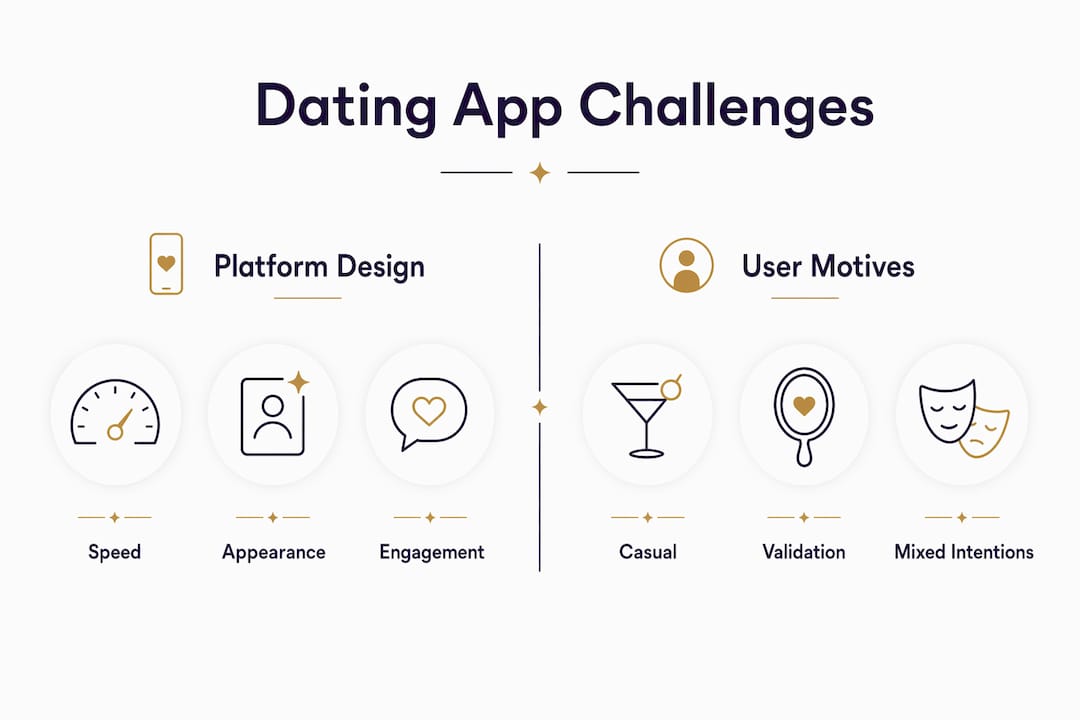
The superficiality you feel on dating apps is not a side effect. It is the product. App design cultivates disposability by fueling endless choice and competition on superficial criteria. The more you swipe, the more time you spend in the app. The more time you spend in the app, the more valuable you are to advertisers and subscription revenue models.
Here is how that design plays out in practice:
- Infinite swiping creates the illusion of unlimited options. Psychologists call this the paradox of choice. More options do not make you happier. They make you less satisfied with every individual person you see.
- Gamification mechanics borrow from slot machine psychology. Matches arrive unpredictably, which triggers dopamine release and keeps you coming back. The reward cycle is built around intermittent reinforcement, the same mechanism behind compulsive behavior.
- Photo-first profiles reduce a person to a thumbnail. You are making a judgment in under a second based on lighting, angles, and aesthetic choices. This is sometimes called "thin slicing," and while humans do it naturally, apps amplify it into the primary evaluation method.
- Engagement-penalizing depth is the least discussed problem. Deeper connections reduce in-app engagement because once two people meet offline, they stop using the app. Depth is a commercial threat. So the design discourages it.
Pro Tip: Set a hard limit of 15 minutes per session on any dating app. Research on decision fatigue shows that longer sessions produce worse choices, not better ones. Shorter, intentional sessions reduce the snap-judgment spiral.
The result is a dating app user experience that rewards speed and appearance while quietly punishing patience and depth. You are not imagining it.
How mixed user motives make shallow interactions worse
Not everyone on a dating app wants what you want. That sounds obvious, but the scale of the mismatch is striking. A study of 44,435 dating app users found that people use these platforms for a wide spectrum of reasons, from serious partnership to boredom relief to self-esteem validation. When those motives collide in the same conversation, the result is confusion, disappointment, and interactions that go nowhere.
Here is how the motive mismatch typically unfolds:
- Validation seekers match with you to feel attractive, not to connect. They respond warmly at first, then disappear once the ego boost is secured. You are left wondering what you did wrong. You did nothing wrong.
- Boredom browsers treat the app like a social media feed. They are not in a mindset for vulnerability or real conversation. The interaction feels hollow because it is. They are killing time, not building closeness.
- Casual-only users may present ambiguously because the platform does not require honesty about intentions. The mismatch only becomes clear after emotional investment has already occurred.
- Serious daters often bring high expectations into an environment that structurally discourages depth. The gap between what they want and what the platform delivers produces the most acute sense of disconnection.
Mismatched dating motives suppress vulnerability and deepen superficial conversations, because users' intentions fluctuate and rarely align in the same interaction. This is not a character flaw in the people you are matching with. It is a predictable outcome of placing people with wildly different needs into the same gamified space without any mechanism for filtering by genuine intent.
Hookup culture dominates dating apps partly because the design rewards casual engagement over serious pursuit. The platform shapes the behavior, not just the other way around.
What dating app burnout actually does to you
Burnout is the word people use casually, but the psychological reality is more specific and more serious. Dating app burnout is characterized by emotional exhaustion, depersonalization, and a growing sense of ineffectiveness. A meta-analysis covering 26,000 people found that dating app users report worse psychological health outcomes compared to non-users. That is not a small finding.
| Burnout symptom | What it looks like on a dating app |
|---|---|
| Emotional exhaustion | You feel drained after scrolling, not energized |
| Depersonalization | You start seeing matches as interchangeable, not as individuals |
| Reduced empathy | Conversations feel transactional; you stop investing emotionally |
| Cynicism | You assume bad faith before anyone has said anything |
| Ineffectiveness | You feel like nothing you do leads anywhere meaningful |
Communication overload and irrelevant messages significantly undermine the ability to engage meaningfully on dating apps. A Structural Equation Modelling study found that stressors like information irrelevance and technological vulnerabilities directly increase the likelihood of users abandoning the platform entirely due to exhaustion. That is the body's way of protecting itself from a system that was never designed with your wellbeing in mind.
The cynicism that develops is particularly damaging because it becomes self-reinforcing. You enter conversations with lower expectations. You invest less. The other person senses that and mirrors it back. The interaction confirms your belief that the app is shallow. The cycle continues.
Pro Tip: If you notice yourself feeling irritable or emotionally flat after using a dating app, that is burnout signaling, not pickiness. Taking a full week off resets your baseline and often produces noticeably better interactions when you return.
How quick judgments and sexualized profiles deepen the shallow feeling
The way people present themselves on dating apps, and the way those presentations are judged, compounds every problem described above. Research published in Cyberpsychology shows that sexualized profiles decrease perceived partner competence and long-term suitability. The person posting the image may be trying to attract attention in a crowded feed. The viewer interprets it as a signal of casual intent and lower relational value. Both parties lose.
This is the thin-slice problem in action. You are not evaluating a person. You are evaluating a curated set of signals designed for a platform that rewards visual impact. Thin-slice fatigue builds as users swipe and judge on limited cues, increasing reliance on stereotypes and snap judgments that deepen superficiality over time.
The comparison below shows how profile choices shift perception:
| Profile type | Viewer perception | Relational outcome |
|---|---|---|
| Sexualized images only | Casual intent, lower competence | Fewer serious inquiries |
| Humanizing details added | Warmer, more multidimensional | Higher emotional investment |
| Shared values or interests | Compatibility signal | Deeper initial conversations |
Profiles that combine humanizing details with genuine interests actively counteract the shallow-judgment default. Authentic online dating is possible, but it requires deliberate choices that run against the grain of how most people have been trained to present themselves on these platforms.
The uncomfortable truth is that both sides of a match are often performing for an algorithm rather than reaching toward another person. That performance is what feeling disconnected on dating apps actually looks like from the inside.
Key takeaways
Dating apps feel superficial because their design, user motives, psychological costs, and profile norms all push toward speed and appearance rather than closeness and care.
| Point | Details |
|---|---|
| Design drives superficiality | Apps optimize for swiping time, not connection quality, making depth commercially undesirable. |
| Motive mismatch is structural | A 44,435-person study confirms users pursue validation, boredom relief, and serious dating simultaneously in the same space. |
| Burnout is clinically real | A meta-analysis of 26,000 users links dating app use to emotional exhaustion, depersonalization, and reduced empathy. |
| Profiles shape perception | Sexualized images lower perceived partner value; humanizing details actively improve relational outcomes. |
| Intentional use helps | Session limits, motive clarity, and platform choice reduce the psychological cost of online dating. |
What I actually think about the superficiality problem
I have spent a long time reading the research on this, and the conclusion I keep returning to is this: most people blame themselves for the shallow experience when the platform is the primary cause. That self-blame is the most damaging part of the whole cycle.
When a conversation goes nowhere, you wonder if you were interesting enough. When a match disappears, you question your worth. But the design was never built to reward depth. It was built to reward continued presence in the app. You were playing a game where the rules were stacked against the outcome you actually wanted.
What I find genuinely useful is separating the platform problem from the personal one. The platform problem is real and well-documented. The personal one, meaning your capacity for warmth, care, and real connection, is almost certainly intact. It just has nowhere to go in an environment that treats people as interchangeable.
Care-based dating is not a soft concept. It is a structural one. When a platform is built around presence and warmth rather than swiping volume, the interactions that happen inside it feel fundamentally different. Not because the people are different, but because the room they are standing in has different rules.
The most practical shift I can suggest is this: stop trying to win at a game designed to keep you playing. Start looking for spaces where the goal is actually connection.
— Albert
A different kind of room exists
If the swiping cycle has left you feeling hollow, you are not alone in that room. And there is another room entirely.
Sidefocusapp was built specifically for men who want closeness, warmth, and presence without the performance that mainstream apps demand. There is no app store installation, no endless feed, and no gamified matching designed to keep you scrolling. What you get instead is unlimited messaging, a genuine community, and a space where the point is actually connection. The door is small on purpose. It is built for people who know what they are looking for and are tired of platforms that profit from them never finding it. If that sounds like you, explore Sidefocusapp and see what a care-centered space actually feels like.
FAQ
Why do dating apps feel so shallow compared to meeting in person?
Dating apps reduce people to photos and short bios, which forces snap judgments based on limited cues. In-person meetings allow tone, body language, and presence to communicate depth that a profile simply cannot carry.
Can dating app burnout affect your mental health?
Yes. A meta-analysis of 26,000 users found that frequent dating app use is associated with worse psychological health outcomes, including emotional exhaustion and depersonalization, compared to non-users.
Do all dating apps have the same superficiality problem?
Most mainstream apps share the same engagement-first design logic, which structurally discourages depth. Platforms built around community, unlimited messaging, and care-centered values produce measurably different interaction patterns.
Why do matches go silent so often on dating apps?
Mixed user motives are the primary cause. Research on 44,435 users shows that many people use apps for validation or boredom relief rather than genuine connection, which means conversations end once the immediate psychological need is met.
Does how you set up your profile affect the quality of connections?
Significantly. Profiles that include humanizing details and shared interests generate deeper initial conversations, while sexualized images lower perceived relational suitability and attract interactions focused on casual intent.