
Dating apps reduce people to profiles by design, turning complex human beings into curated snapshots that others swipe past in under two seconds. Platforms like Tinder and Coffee Meets Bagel are built to keep you scrolling, not to help you fall in love. The technical term for this phenomenon is profile commodification, and 2026 research confirms it shapes not just how we date, but how we see each other. Understanding how apps affect dating at a structural level is the first step toward reclaiming something more real.
How dating apps reduce people to profiles through design
The mechanics of most dating apps are not neutral. They are built to optimize engagement, not emotional connection. Every swipe, every notification, every "someone liked you" alert is engineered to pull you back into the feed. The result is a system where people become options, not partners.
Researcher Sameh Al Natour describes this as systemic. Platform design trains users to evaluate others as data points rather than relational humans. The feeling that "something better is just one more swipe away" keeps users engaged while quietly reinforcing the idea that every person is replaceable. That is not a side effect. It is the business model.
Key design elements that drive profile reduction include:
- Infinite swiping mechanics that reward speed over reflection
- Gamified match notifications that trigger dopamine responses, not emotional investment
- Algorithmic ranking that surfaces profiles based on engagement signals, not compatibility depth
- Limited character counts that force users to compress identity into bullet points
- Photo-first layouts that make appearance the primary filter before any words are read
These features combine to create what researchers call a competitive dating culture, where social hierarchies are reinforced and depth is penalized by the interface itself.
Pro Tip: Once you recognize these mechanics for what they are, you can use the app more intentionally. Set a daily time limit, write to people before swiping more, and treat each profile as a person who exists outside the screen.
Does profile format actually change how we see someone?
Yes, and the research is striking. A 2026 APA study involving 594 participants across three experiments found that narrative dating profiles generate significantly more empathy and romantic interest than the standard "shopping list" format. Storytelling activates a different kind of attention. It invites you into someone's world rather than asking you to assess their specs.
Think about the difference between reading "I love hiking, coffee, and dogs" versus "Last summer I got lost on a trail in Colorado and ended up sharing trail mix with a stranger for two hours. Best conversation I've had in years." The second version creates presence. You feel the person, not just their attributes.
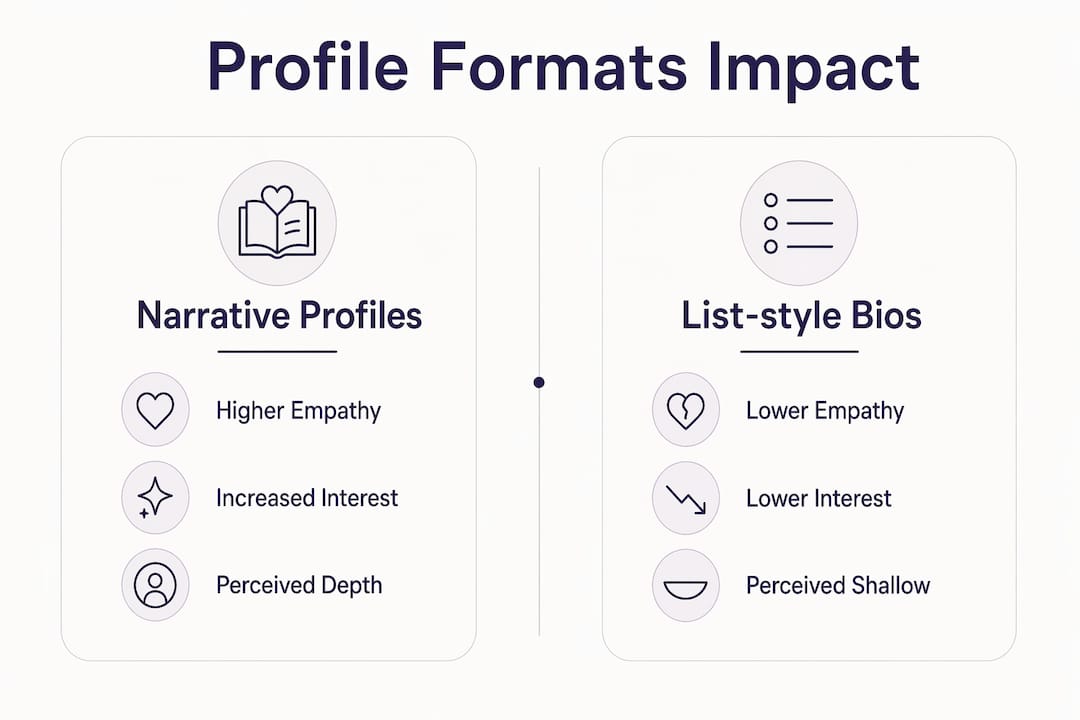
Photo context matters too. A photo of someone laughing at a dinner table tells a different story than a posed gym selfie, even if the person is equally attractive in both. Context signals personality, warmth, and social ease. These are things a list of traits simply cannot convey.
| Profile format | Empathy level | Romantic interest | Perceived depth |
|---|---|---|---|
| Narrative (storytelling) | High | Higher than list format | Strong sense of personhood |
| List-style ("shopping list") | Low | Lower baseline interest | Feels like a resume |
| Photo-only with minimal text | Very low | Attention-grabbing but shallow | Reduced to appearance |
| Narrative with contextual photos | Highest | Strongest sustained interest | Full human impression |
The data is clear. Humanizing profiles through storytelling activates empathy and higher romantic interest, showing that the format of a profile is not cosmetic. It is relational.
What do sexualized profile photos actually signal?
Sexualized images attract fast attention. That part is true. But 2026 research by Gurit Birnbaum reveals a more complicated picture. Sexualized profiles reduce interest in long-term relationships, even when the person is objectively attractive. Viewers register the body before the person, and that initial framing is hard to undo.
The problem deepens when there is incongruence between the photo and the bio. A highly sexualized image paired with a vulnerable, emotionally open bio creates cognitive dissonance. Research finds that gender differences in perception shape how this incongruence lands, with some demographics reading it as confusing or untrustworthy rather than layered or interesting.
Here is what this means in practice:
- Sexualized photos can generate clicks but reduce the likelihood of meaningful conversation
- Profiles that lead with body-focused images are more likely to attract attention seeking short-term contact
- When a sensitive or emotionally rich bio follows a sexualized photo, the mismatch can undermine trust rather than build intrigue
- Being perceived as "only a body" is a real risk that limits how others engage with your full self
Pro Tip: You do not have to choose between being attractive and being seen as a whole person. Lead with a photo that shows you in a real moment, smiling, doing something you love, or with people who matter to you. Save the more striking images for later in your photo set, once someone is already curious about who you are.
How does app overload push people toward exhaustion?
Profile-based evaluation does not just flatten people. It wears users down. A 2026 study published in Current Psychology identifies three primary stressors driving what researchers call dating app exhaustion: communication overload, information irrelevance, and technological vulnerability. Each one degrades the quality of engagement and erodes trust over time.
Communication overload happens when the volume of messages, matches, and notifications exceeds a person's capacity to respond meaningfully. Information irrelevance occurs when the content of profiles and conversations feels disconnected from what someone actually wants. Technological vulnerability refers to concerns about privacy, data misuse, and the emotional exposure that comes with sharing personal details on a commercial platform.
| Stressor | What it looks like | Outcome for the user |
|---|---|---|
| Communication overload | Too many matches, messages, and alerts | Reduced response quality, emotional withdrawal |
| Information irrelevance | Profiles that feel generic or misaligned | Disengagement, faster swiping, less care |
| Technological vulnerability | Privacy concerns, fear of data misuse | Reduced trust, reluctance to share authentically |
| Combined stressor effect | All three present simultaneously | Discontinuation intentions, full app abandonment |
The study also found that trust moderates these effects. Users with lower trust in the platform experience stronger intentions to quit when stressors pile up. This matters because dehumanization in dating apps is not just a philosophical concern. It has measurable psychological costs that push people away from connection entirely. If you have ever felt like you needed a break from apps, that feeling has a name and a cause. You can read more about it in this piece on dating app fatigue.
Practical ways to counteract profile reduction
Reducing romance to profiles is a system-level problem, but you can push back at the individual level. The goal is to show up as a full person and invite others to do the same. Here is how:
- Write a narrative bio, not a list. Describe a specific moment, memory, or habit that reveals something true about you. "I make elaborate Sunday breakfasts for no one in particular" says more than "I love cooking."
- Choose photos with context. Show yourself in a real setting, doing something that matters to you. Context creates conversation starters and signals depth.
- Avoid leading with sexualized images. Research confirms this reduces long-term interest. Save attention-grabbing photos for later in your set, after you have established some personality.
- Limit your daily swiping time. Overuse accelerates the habit of rapid, shallow evaluation. Thirty focused minutes beats two hours of mindless scrolling.
- Ask one genuine question early. Move away from "hey" and toward something that references their profile specifically. It signals that you read it, which is already rare enough to stand out.
- Prioritize depth over volume. Three real conversations are worth more than thirty matches that go nowhere. Quality engagement is the antidote to the disposability that app design reinforces.
These strategies work because they interrupt the default mode the app is designed to keep you in. You can also explore authentic online dating examples that show what this looks like in practice.
Key takeaways
Dating apps reduce people to profiles through deliberate design choices that prioritize engagement over connection, but narrative profiles, mindful photo selection, and reduced communication volume can restore genuine human presence to the experience.
| Point | Details |
|---|---|
| App design drives commodification | Infinite swiping and gamification train users to treat people as replaceable options. |
| Narrative profiles build empathy | APA research shows storytelling formats generate more romantic interest than list-style bios. |
| Sexualized photos limit long-term appeal | Birnbaum's 2026 research confirms they attract attention but reduce serious relationship interest. |
| Overload causes real exhaustion | Communication overload and technical vulnerability drive users toward quitting apps entirely. |
| Intentional use changes outcomes | Limiting swiping time, writing narratively, and asking genuine questions counteract profile reduction. |
What I've learned from watching people disappear into profiles
I have spent a long time thinking about what gets lost when a person becomes a profile. And what strikes me most is not the swiping itself. It is the quiet acceptance that this is just how dating works now.
The research tells one part of the story. Apps are designed to keep you engaged, not to help you find closeness. That is a structural reality. But the deeper issue is what happens to us when we internalize that logic. We start scanning people the way we scan menus. We optimize our own profiles like we are products. We feel the exhaustion but keep scrolling because stopping feels like giving up.
What I believe, and what the 2026 data supports, is that the antidote is not abandoning technology. It is using it with more intention and more warmth. Narrative profiles work because they remind both the writer and the reader that there is a whole person here. Not a set of traits. Not a body. A person with a story worth hearing.
The platforms that will matter going forward are the ones built around that truth. Not around engagement metrics. Around belonging.
— Albert
A different kind of room
Most dating apps are built like shopping malls: bright, busy, and designed to keep you browsing. Sidefocusapp is built more like a room where people actually talk. It was created specifically for men who identify as Sides, those who want closeness, warmth, and genuine intimacy without the performance that most platforms demand. There is no endless swiping here. No gamified match queue. Just unlimited messaging and a community that values presence over profile. If you are tired of being reduced to a set of data points, find your place at Sidefocusapp, where connection is the whole point.
FAQ
How do dating apps reduce people to profiles?
Dating apps use photo-first layouts, limited text fields, and infinite swiping mechanics that force users to make rapid judgments based on curated snapshots. This design trains both viewers and profile owners to compress identity into a few data points rather than engage with the full person.
Do narrative profiles actually work better than list-style bios?
Yes. A 2026 APA study with 594 participants found that narrative dating profiles generate significantly more empathy and romantic interest than standard list-style formats. Storytelling activates emotional engagement that bullet points simply cannot replicate.
Why do sexualized dating profile photos backfire?
Sexualized photos attract quick attention but reduce perceived suitability for long-term relationships, according to Gurit Birnbaum's 2026 research. When a sexualized image is paired with an emotionally open bio, the mismatch can undermine trust rather than signal depth.
What causes dating app exhaustion?
A 2026 Current Psychology study identifies communication overload, information irrelevance, and technological vulnerability as the three primary stressors driving dating app exhaustion. Together, they degrade engagement quality and increase the likelihood that users will quit the platform entirely.
Can you use dating apps without being reduced to a profile?
You can reduce the effect by writing narrative bios, choosing contextual photos, limiting daily swiping time, and prioritizing genuine conversation over match volume. These practices interrupt the default evaluation mode that most app designs encourage.