
Transactional dating is defined as a relationship approach where interactions revolve around explicit exchanges of value, such as money, status, or physical intimacy, rather than emotional bonds. Transactional dating involves explicit quid pro quo exchanges with the expectation of a defined return. This is not the same as healthy give and take. It is a pattern where both people keep score, and the relationship ends when the returns stop. With 39% of U.S. adults using dating apps in 2026, rising to 65% for adults aged 18–29, the conditions that breed transactional thinking have never been more widespread. Understanding this dynamic is the first step toward choosing something different.
What is transactional dating explained in plain terms?
Transactional dating is a relationship style built on conditional exchange rather than genuine closeness. One person gives something, and they expect something specific back. The relationship only continues as long as both sides feel the trade is fair. Psychologists sometimes call this a "quid pro quo" dynamic, meaning "something for something." It differs from healthy reciprocity, which flows naturally over time without anyone keeping a running tab.
The clearest examples are dating for financial support, dating for social status, or dating primarily for physical access. These arrangements are not always hidden or dishonest. Sometimes both people agree to the terms. The problem arises when one person believes the exchange entitles them to more than the other is willing to give, or when the arrangement quietly replaces real care and warmth.

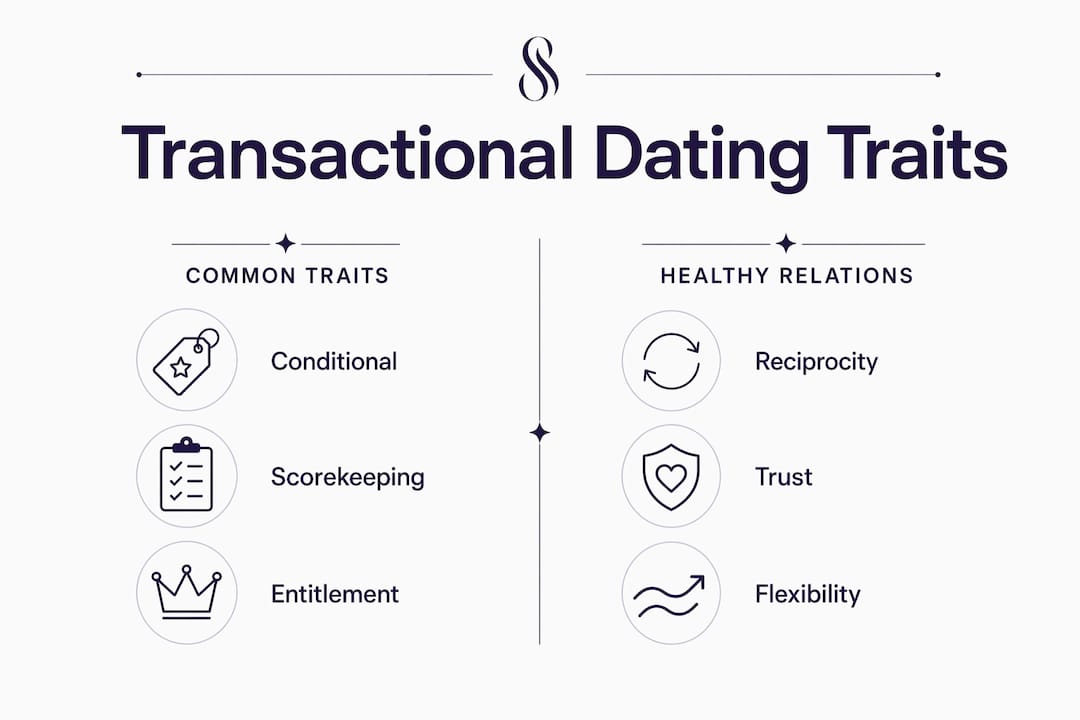
Healthy reciprocity is fluid over time, while transactional relationships rely on explicit, immediate returns. That distinction matters. A relationship where you sometimes give more and sometimes receive more is healthy. A relationship where every gesture is mentally logged as a debt is not.
What are the key characteristics of transactional dating?
Transactional dating has a recognizable set of behaviors. Once you know what to look for, the pattern becomes hard to miss.
- Scorekeeping. One or both people track favors, expenses, and gestures as debts. Scorekeeping is a red flag in any relationship. Meaningful bonds involve long-term reciprocity without tallying every act of care.
- Conditional affection. Warmth and attention are given only when the other person delivers what is expected. Affection disappears the moment the exchange feels unequal.
- Limited emotional depth. Conversations stay focused on logistics, plans, and what each person wants. Vulnerability and genuine curiosity about the other person are rare.
- Clear exit conditions. The relationship ends when the expected return stops. There is little interest in working through difficulty or growing together.
- Entitlement thinking. One person believes their investment, whether money, time, or effort, earns them specific rights over the other person's behavior or body.
These patterns show up across all genders and relationship types. They are not limited to arrangements involving money. Seeking validation, chasing social status, or using a partner as emotional labor without offering care in return all qualify as transactional behavior.
Pro Tip: Ask yourself whether you would still want to spend time with this person if they could no longer offer what you currently receive from them. Your honest answer reveals a lot about the nature of the connection.
How do digital dating platforms shape transactional behavior?
Dating apps train people to make fast, visual judgments. App mechanics like swiping encourage market-like evaluation, where people are assessed quickly and discarded just as fast. That habit of rapid filtering is the opposite of what emotional availability requires. Building real closeness takes time and a tolerance for uncertainty. Apps reward neither.
The abundance of choice on digital platforms creates a psychological effect researchers call commodification. When you believe there is always another option one swipe away, you are less likely to invest in the person in front of you. Emotional burnout in dating apps drives people toward transactional behaviors as a defense mechanism, which further limits intimacy. It becomes a cycle. The app exhausts you, you protect yourself by staying surface-level, and the connection never deepens.
78% of dating app users report emotional exhaustion related to transactional dating dynamics. That is not a minor side effect. It signals a structural problem with how these platforms are designed. Gamification and swiping create feedback loops that reinforce viewing partners as options rather than people.
| Platform behavior | Effect on dating mindset |
|---|---|
| Rapid swiping and filtering | Trains quick rejection over patient curiosity |
| Infinite choice of profiles | Creates fear of missing out and reduces commitment |
| Gamified matching systems | Rewards volume of matches over depth of connection |
| Appearance-first presentation | Prioritizes surface evaluation over personality |
Pro Tip: If you notice yourself swiping out of boredom rather than genuine interest, that is a signal to step back. Dating without apps is a real option, and it often produces far more grounded connections.
What are the emotional and relational effects of transactional dating?
The emotional cost of transactional dating is real and cumulative. When every interaction is filtered through "what do I get from this," genuine vulnerability becomes impossible. You cannot be truly open with someone you are also quietly evaluating as a trade partner. Over time, this erodes the capacity for the kind of closeness that makes relationships feel worth having.
"The shift from 'What can I get?' to 'How can we grow together?' is what sustains emotional bonds." This reframe, cited by relationship researchers, captures exactly what transactional dating prevents.
Consent is another casualty. People use prior expenditures like expensive dinners as justification for expecting physical intimacy. That logic is both common and harmful. Spending money on someone does not create an obligation. When that belief goes unchallenged, it generates pressure that complicates dating for everyone involved, regardless of gender.
The social dynamics around transactional dating are also uneven. Societal pressures create entitlement linked to financial spending as a basis for intimacy expectations. Women often face pressure to perform gratitude for gestures they did not request. Men often feel that effort should guarantee a specific outcome. Neither experience supports the kind of safety that real closeness requires.
Here is what transactional dating costs emotionally:
- Reduced trust. When you suspect someone's care is conditional, you stop believing it is real.
- Emotional guardedness. Both people stay defended, which prevents the vulnerability that builds lasting bonds.
- Resentment. Unmet expectations breed bitterness, especially when the "terms" were never clearly spoken.
- Stunted growth. Relationships that run on exchange logic rarely push either person to become more patient, generous, or self-aware.
Transactional exchanges can work in professional contexts, but they become harmful in romantic ones when they replace care and empathy. The difference is context. A business deal is supposed to be transactional. A relationship is not.
How can you recognize and move past transactional dating patterns?
Recognizing the pattern is the most useful thing you can do. Most people in transactional dynamics do not label them that way. They just feel vaguely unsatisfied, like something is missing, without knowing what it is.
- Watch for the "what have you done for me lately" feeling. If your warmth toward someone rises and falls based on what they recently gave you, that is scorekeeping. Healthy affection does not work on a ledger.
- Notice whether you feel free to say no. In a transactional dynamic, saying no to a request often triggers withdrawal of affection or outright conflict. That pressure is a clear sign the relationship is conditional.
- Ask whether you know this person deeply. Transactional relationships stay shallow by design. If you have been seeing someone for months and still do not know what genuinely matters to them, the connection may be exchange-based rather than relational.
- Slow down the evaluation process. Opting out of rapid swiping is necessary to reset your psychological approach from market-like to relational. The same principle applies offline. Give people more time before deciding they are not worth knowing.
- Set clear, honest expectations early. Transparency does not make a relationship transactional. Hiding your expectations and then resenting unmet ones does. Say what you want. Ask what the other person wants. Build from there.
- Prioritize emotional curiosity. Ask questions that go beyond logistics. What does this person fear? What do they love? What shaped them? Prioritizing emotional curiosity disrupts transactional patterns more effectively than any rule or boundary.
The goal is not to eliminate all expectations from a relationship. Expectations are normal and healthy. The goal is to distinguish long-term reciprocity from scorekeeping, and to choose partners who are interested in growing together rather than settling a tab.
Key Takeaways
Transactional dating replaces genuine care with conditional exchange, and recognizing that pattern is the clearest path back to real intimacy.
| Point | Details |
|---|---|
| Core definition | Transactional dating is built on explicit quid pro quo exchanges, not emotional investment. |
| Digital amplification | Dating app mechanics like swiping train market-like evaluation and reduce emotional availability. |
| Consent risk | Spending money or effort does not create entitlement to intimacy; that belief harms all genders. |
| Emotional cost | Scorekeeping erodes trust, vulnerability, and the capacity for lasting closeness. |
| Path forward | Slow down, prioritize emotional curiosity, and shift from "what do I get" to "how do we grow." |
What I have learned from watching dating culture shift
I have spent years paying attention to how people talk about dating, and the language has changed in ways that concern me. People now describe potential partners the way they describe job candidates. They talk about "green flags" and "red flags" as if they are running a performance review. They ghost without guilt because the other person was just one of many options in a queue.
That efficiency mindset makes sense as a defense. Dating is genuinely exhausting, and protecting yourself from repeated disappointment is rational. But the defense becomes the problem. When you approach every new person as a potential transaction, you close the door on the kind of slow, uncertain, slightly awkward closeness that actually feels like something.
The superficial dynamics built into most dating platforms make this worse. They reward speed and volume, not patience and presence. Opting out, even partially, changes what you are available for. I have seen people find more genuine connection in one honest conversation than in months of swiping. Vulnerability is not a weakness in dating. It is the whole point. Choosing to be present with someone, without knowing exactly what you will get back, is what makes intimacy possible. That is not naive. It is the only thing that actually works.
— Albert
Where Sidefocusapp fits into this conversation

Sidefocusapp was built for men who already know that warmth and closeness matter more than a high match count. The platform is designed around genuine presence rather than performance, which means the environment itself discourages the scorekeeping and surface-level evaluation that make transactional dynamics so common elsewhere. There is no app store installation required, no gamified swiping loop, and no pressure to perform. Unlimited messaging and community engagement give you the space to actually know someone. If you are ready to step out of the exchange mindset and into something that feels real, Sidefocusapp is a room worth walking into.
FAQ
What is the transactional dating meaning in simple terms?
Transactional dating is a relationship dynamic where both people exchange value, such as money, status, or intimacy, with clear expectations of return rather than emotional connection.
Is transactional dating healthy?
Transactional exchanges work in professional settings but become harmful in romantic relationships when they replace genuine care, empathy, and vulnerability with conditional giving.
How does transactional dating differ from traditional dating?
Traditional dating prioritizes emotional connection and long-term reciprocity. Transactional dating focuses on immediate, explicit returns and typically ends when one party stops delivering the expected value.
What are the biggest red flags of a transactional relationship?
Scorekeeping, conditional affection, entitlement after spending money or time, and shallow communication that never moves beyond logistics are the clearest warning signs.
Can transactional dating patterns be changed?
Yes. Slowing down the evaluation process, practicing emotional curiosity, and setting honest expectations early all help shift a relationship from exchange-based to genuinely relational.