
Gamification in dating apps is defined as the use of game mechanics like points, badges, levels, and rewards to make partner selection feel interactive and emotionally engaging. Tinder's swipe mechanic alone generated 1 billion daily swipes within two years of launch. That number tells you something important: people were not just looking for dates. They were hooked on the experience itself. Apps like Tinder, Bumble, and Hinge have each built their core product around psychological triggers borrowed from game design, turning the search for connection into something that feels a lot like play.
What is gamification in dating apps and how does it work?
Gamification in dating apps is the deliberate application of game design principles to the process of meeting and connecting with people online. The industry term for this practice is "behavioral design," and it draws directly from psychology research on motivation and reward. Every swipe, match notification, and daily limit you encounter is a designed choice, not a default.
The mechanics work because they tap into how the human brain processes reward. When you swipe right and get a match, your brain releases dopamine. That feeling is brief, so you swipe again. This loop mirrors the variable ratio reward schedule used in slot machines, where unpredictable rewards produce the strongest habitual behavior. Dating apps did not stumble onto this by accident. They built it in.

Scarcity is another core tool. Apps that cap your daily likes force you to slow down and choose deliberately. Users with limited daily likes report more thoughtful swiping behavior because each action feels more meaningful. That is scarcity bias at work. The fewer likes you have, the more each one feels like a real decision.
What gamification features are commonly used in dating apps?
Dating apps use a consistent set of game mechanics, each targeting a different part of user behavior.
- Swipe mechanics. The left/right swipe is the most recognized gamification feature in dating. It reduces a complex human judgment to a binary choice, making the action fast and repeatable.
- Super Likes and boosts. These are premium actions that signal elevated interest. They function like power-ups in a game, giving users a way to stand out beyond the standard swipe.
- Daily limits. Capping free swipes creates artificial scarcity. Users feel urgency to use their remaining likes wisely, which increases perceived value per action.
- Badges and profile completeness scores. Hinge uses a "Your Turn" badge to show whose move it is in a conversation. Badges reduce ambiguity and push users toward action.
- Timed windows. Bumble's 24-hour match expiration is one of the clearest examples of time pressure in dating apps. The 24-hour expiration pushes users from passive browsing into active conversation.
- Interactive icebreakers and quizzes. Some platforms use personality prompts and mini-games to shift the opening exchange away from "hey" toward something with actual substance.
Pro Tip: If you use a platform with daily like limits, treat them like a real budget. Spend each one on someone you genuinely want to talk to, not someone you might message someday.
The combination of these features creates a feedback loop. You act, you get a response, you feel rewarded, and you return. That cycle is the engine behind most dating app engagement.
How does gamification impact user engagement and emotional investment?
The psychological impact of gamified dating features runs deeper than most users realize. Four mechanisms drive the bulk of the effect.
- Dopamine loops. Every match triggers a small neurological reward. The dopamine-driven swiping habit builds quickly and persists even when the original goal of finding a partner fades into the background.
- Scarcity bias. When something feels rare, it feels more valuable. Limited likes and expiring matches make each interaction feel higher-stakes, which keeps emotional investment elevated.
- Social proof through status tiers. Exclusive platforms like Raya and Tinder Select function as social status progression systems, similar to leveling up in a role-playing game. Getting accepted into these tiers delivers a genuine sense of achievement and belonging.
- Positive feedback loops. Every "like," match, or reply confirms that you are desirable. That confirmation motivates continued use, regardless of whether real connections are forming.
"Gamification mechanics designed to retain users can inadvertently cause dating fatigue through overuse and frustration." — Tinder: The Psychology of Gamification
The risk is real. UX researchers warn that gamification prioritizes retention over resolution, meaning apps are designed to keep you swiping, not to help you stop. That tension between engagement and genuine connection is the central problem with how most dating apps are built today. If you have ever felt like you were swiping out of habit rather than hope, you have experienced dating app fatigue firsthand.
Benefits and drawbacks of gamification for real romantic connections
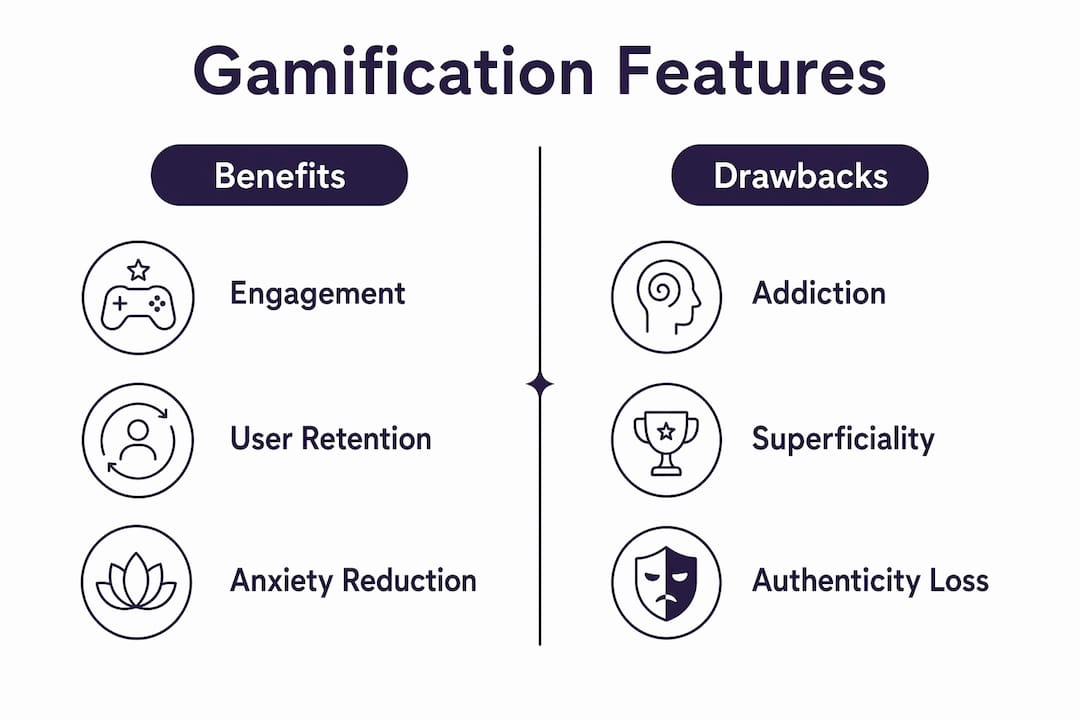
Gamification is not purely harmful or purely helpful. It does specific things well and other things poorly.
| Aspect | Benefit | Drawback |
|---|---|---|
| Conversation starters | Icebreaker games reduce the pressure of opening a chat | Mini-games can feel performative rather than genuine |
| Rejection anxiety | Mutual matching means you only see interest, not rejection | Matching volume can devalue individual connections |
| Message quality | Interactive prompts produce longer, more personal replies | Users may perform for the prompt rather than for the person |
| Engagement | Timed features push passive users into active communication | Time pressure can feel stressful rather than motivating |
| Authenticity | Personality quizzes surface real preferences and values | Gamified mindsets can encourage treating people as options |
Gamified interactive personality challenges increase message length and response rates by shifting focus toward compatibility rather than appearance. That is a genuine benefit. When you answer a Hinge prompt about your most controversial food opinion, you give someone a real entry point into who you are.
The drawback is subtler. Experts note a real tension: increased engagement can cost authenticity and promote transactional attitudes toward dating. When the app feels like a game, people start playing it like one. Matches become scores. Conversations become quests. The warmth that makes connection real gets crowded out by the mechanics designed to simulate it.
Pro Tip: Use gamified features as a starting point, not a destination. Let a quiz or prompt open the door, then step away from the game and have a real conversation.
Examples of gamification in dating apps that build real connections
Some apps use gamification in ways that genuinely serve connection rather than just retention.
- Hinge's "Your Turn" prompts. Hinge structures profiles around questions and answers rather than photos alone. The interactive quizzes and mini-games on Hinge shift focus from superficial swiping toward personality compatibility and deeper early conversations.
- Bumble's messaging window. The time pressure of Bumble's 24-hour window effectively moves users from passive matching to active conversation. It removes the "I'll message them later" delay that kills most matches.
- Raya and Tinder Select. These exclusive tiers use acceptance as a form of social achievement. The sense of belonging to a curated community changes how members interact, often producing more intentional conversations.
- Personality compatibility features. Platforms that pair users based on quiz responses rather than photos alone report higher user satisfaction with match quality.
| App | Key gamification feature | Connection benefit |
|---|---|---|
| Hinge | Prompt-based profiles | Opens personality-first conversations |
| Bumble | 24-hour messaging window | Reduces passive match hoarding |
| Raya | Exclusive acceptance tier | Creates community and belonging |
| Tinder | Super Like | Signals genuine, elevated interest |
The apps that use gamification well treat it as a tool for reducing friction, not for manufacturing addiction. There is a real difference between a feature that helps you start a conversation and one that keeps you swiping past midnight. Knowing that difference helps you use these platforms with more intention. For more on what features build real bonds, the gap between well-designed and poorly-designed platforms becomes clear quickly.
Key takeaways
Gamification in dating apps works because it applies proven psychological triggers to human connection, but the same mechanics that increase engagement can undermine authenticity when left unchecked.
| Point | Details |
|---|---|
| Core definition | Gamification applies game mechanics like rewards, scarcity, and status to the dating experience. |
| Psychological engine | Variable ratio rewards and dopamine loops drive habitual swiping beyond genuine dating intent. |
| Best features | Timed messaging windows and personality prompts push users toward real conversation. |
| Real risk | Gamification prioritizes retention over resolution, leading to dating app fatigue over time. |
| User strategy | Treat gamified features as conversation openers, then shift to authentic, direct communication. |
Why I think most people misread what gamification is actually doing
The conversation around gamification in dating apps usually lands in one of two places: either it is celebrated as clever design or condemned as manipulation. Both miss the point.
What I have come to understand is that gamification is neutral. It is a set of tools. The question is what those tools are pointed at. Bumble's 24-hour window is pointed at action. Hinge's prompts are pointed at personality. Tinder's swipe mechanic is pointed at volume. Each of those choices reflects a different theory of what dating is for.
The problem is not that apps use game mechanics. The problem is that most apps use them to maximize time-on-platform rather than to help you find someone worth your time. Those are opposite goals. An app that genuinely wanted you to find a partner would celebrate the day you deleted it. Most apps are not built for that day.
What I find more useful than criticizing the design is understanding it. When you know that a daily like limit is a scarcity tactic, you can choose to use it deliberately rather than feel pressured by it. When you recognize that a match notification is a dopamine trigger, you can decide whether to act on it or let it sit. Awareness does not remove the pull. But it gives you back some control.
The men I see building real connections through dating apps are not the ones who game the system hardest. They are the ones who use the features lightly and invest their energy in the conversation itself. The app gets you to the door. What happens next is entirely human.
— Albert
How Sidefocusapp approaches connection differently

Sidefocusapp was built for men who already know that swiping is not the same as connecting. If you have felt the pull of gamified features and walked away feeling emptier than when you started, you are not alone. That experience is one of the most common dating app frustrations men describe today.
Sidefocusapp removes the game layer entirely. No daily swipe limits. No match expiration timers. No status tiers designed to make you feel like you need to level up. Just unlimited messaging and a community built around closeness, warmth, and presence. The room is small on purpose. The people in it are here for the same thing you are.
If you are ready to step away from the mechanics and toward something that actually feels like connection, Sidefocusapp is worth your time.
FAQ
What is gamification in dating apps?
Gamification in dating apps is the use of game mechanics like points, badges, swipe limits, and timed features to make the dating experience more interactive and emotionally engaging. The industry term for this practice is behavioral design.
How does Tinder use gamification?
Tinder's swipe mechanic operates on a variable ratio reward schedule, the same psychological principle used in slot machines, which drives habitual swiping beyond actual dating goals.
Does gamification help people find real relationships?
Gamification can help by reducing rejection anxiety and opening personality-based conversations, but experts warn it can also promote transactional attitudes that work against genuine romantic connection.
What is dating app fatigue and how does gamification cause it?
Dating app fatigue is the exhaustion that comes from prolonged, habitual use of apps designed to retain users rather than resolve their search. Gamification mechanics keep people swiping long after their genuine intent has faded.
Which gamification features are most effective for real connection?
Personality prompts like those on Hinge and timed messaging windows like Bumble's 24-hour expiration are the features most consistently linked to deeper, more intentional conversations between matched users.