
Representation on dating platforms is defined as the degree to which users can see, express, and encounter diverse identities, backgrounds, and relationship styles within an app's design, profiles, and matching systems. When you open an app and feel like you belong there, that is representation working. When you scroll through profiles and find no one who looks like you, speaks your language, or shares your experience, that absence shapes every interaction that follows. Understanding why representation matters on dating platforms goes far beyond counting diverse faces in a promotional banner. It reaches into how confident you feel sending that first message, and whether you believe genuine connection is even possible for someone like you.
Why representation matters on dating platforms: the core case
Representation on dating apps directly determines who feels welcome enough to show up fully. Match Group, which operates platforms including Hinge, OkCupid, and Tinder, has documented how profile design and filter options shape user behavior at scale. BLK, a platform built specifically for Black singles, exists precisely because mainstream apps failed to provide that sense of belonging. The importance of diversity in dating is not a branding choice. It is a structural one that affects whether real relationships form.
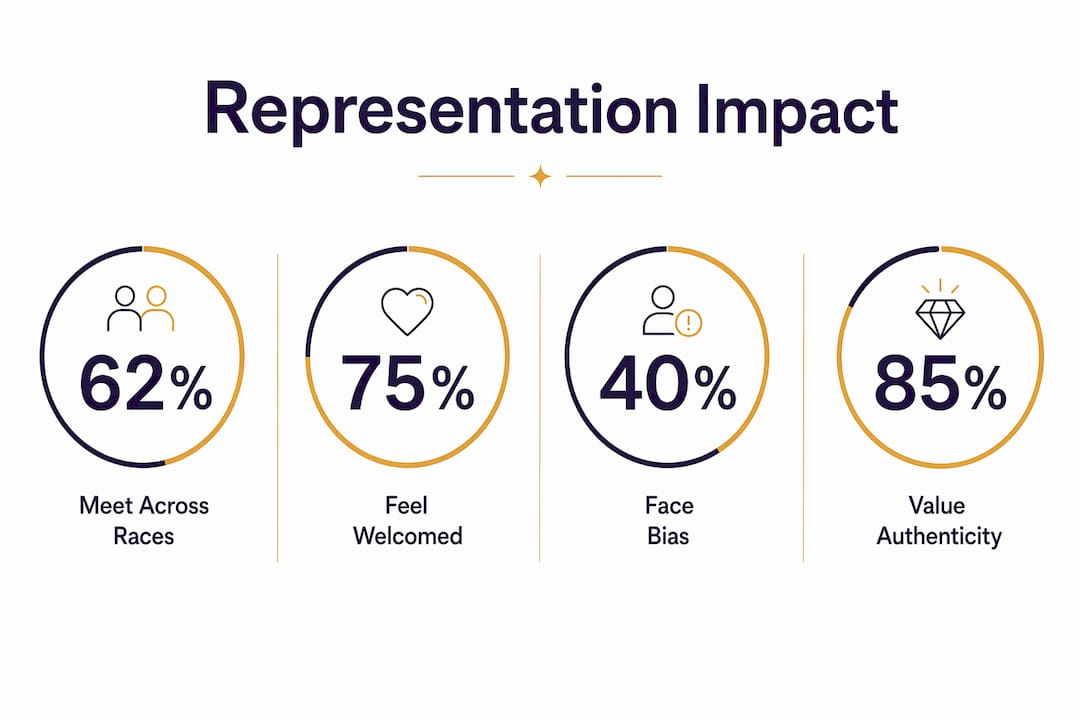
62% of people surveyed agree that dating apps help them meet people of different races and backgrounds, expanding their dating pools in ways their immediate communities cannot. That number, drawn from a survey of more than 17,000 people across several countries, tells us that apps carry genuine potential for cross-cultural connection. The potential only becomes reality when the platform is designed to support it.

How does representation expand your dating pool?
When a platform reflects diverse identities, users encounter people they would never meet through neighborhood proximity or workplace overlap. That expansion matters because geographic and social circles remain deeply segregated in many parts of the United States.
| Dating Pool Factor | Without Inclusive Representation | With Inclusive Representation |
|---|---|---|
| Racial and ethnic diversity | Limited to dominant group defaults | Actively surfaced across groups |
| Identity expression options | Binary or narrow categories | Broad, self-defined options |
| Matching across backgrounds | Rare, algorithm-suppressed | Encouraged by design |
| Sense of belonging for minorities | Low, often absent | Supported by community features |
| Cross-cultural connection rate | Minimal | Measurably higher |
The table above shows that representation is not just about adding a checkbox. It changes the entire architecture of who gets seen and who gets chosen. Platforms that treat diversity as a UI feature rather than a relational priority produce hollow results. The effects of representation on online dating ripple outward from the first swipe to the first real conversation.
Pro Tip: When evaluating a dating app's commitment to diversity, look past the profile fields. Check whether the platform's matching logic actively surfaces people outside your immediate demographic bubble, or whether it quietly defaults to same-race, same-background suggestions.
What challenges and biases still exist on dating apps?
Representation on a platform does not automatically remove bias from the people using it. The gap between visible diversity and lived experience is wide, and the research makes that gap concrete.
A 2022–2023 survey experiment that manipulated ethnoracial identity in dating profiles found that Black women face disadvantages in online dating markets, particularly when evaluated by less educated White respondents. That finding is not a minor data point. It means that the same profile, with the same warmth and the same words, receives a measurably different reception based on race and the evaluator's educational background.
The same study found that higher education among White respondents correlates with greater openness to cross-ethnoracial romantic connections. Education moderates bias. That is a meaningful lever, but it is not one that dating platforms control directly.
Here is what users from marginalized groups actually report experiencing on mainstream apps:
- Identity interrogation. Being asked to explain or justify your cultural background before a conversation reaches any real depth.
- Exoticization. Receiving messages that treat your race or ethnicity as the primary attraction rather than you as a person.
- Stereotype-based filtering. Being passed over because of assumptions tied to your background, not your actual profile content.
- Exhaustion from repeated bias. 57% of Black British singles report experiencing racism or bias on mainstream dating apps, leading to what researchers describe as identity fatigue.
Identity fatigue is real. It is the cumulative weight of having to defend your presence on a platform that was not built with you in mind. That fatigue does not just reduce engagement. It pushes people toward community-specific platforms or off dating apps entirely.
Pro Tip: Superficial representation, such as adding ethnicity filters without addressing moderation or prompt design, can make the experience worse, not better. It signals inclusion while delivering the same biased environment. Look for platforms that show evidence of active moderation and community standards.
Does authentic representation actually build stronger connections?
Authentic representation is defined as portraying identities with cultural grounding, relatable context, and genuine specificity rather than token visibility. A UCLA report on representation authenticity found that authentic cultural grounding and relatable roles strongly predict audience connection and engagement. That principle translates directly to dating profiles and platform design.
When you see a profile that reflects your actual world, your language, your references, your values, you do not just feel seen. You feel safe enough to be honest. That safety is the foundation of real connection. Platforms that encourage authentic online dating profiles produce users who show up more fully, which leads to conversations with more warmth and less performance.
| Representation Type | User Experience | Connection Quality |
|---|---|---|
| Superficial (token diversity) | Visible but not relatable | Surface-level, often performative |
| Authentic (culturally grounded) | Recognized and understood | Deeper, trust-based, more durable |
| Community-specific platforms | High belonging, lower reach | Strong within-group bonds |
| Mainstream with inclusive design | Broader reach, variable depth | Depends on moderation quality |
The UCLA research also found that authenticity judgments are strongest when the audience shares the identity being portrayed. This means that a Black user evaluating a platform's representation of Black identity will read inauthenticity immediately. You cannot fake cultural fluency. Platforms that try often produce an experience that feels more alienating than no representation at all.
How do algorithms shape who you actually see?
Platform design and matching logic are where representation either lives or dies in practice. The algorithm is not neutral. It reflects the values, assumptions, and commercial priorities of the people who built it.
- Ethnicity-based matching defaults. Patent evidence from Match Group apps shows that algorithms match users by ethnicity and physical traits, which can reinforce existing social hierarchies rather than challenge them.
- Desirability scoring. Some platforms assign implicit desirability scores based on who swipes on whom. These scores compound racial bias because they reflect existing societal preferences rather than correcting for them.
- Filter design as gatekeeping. When users can filter by race and those filters are set as defaults, the platform actively narrows the dating pool for minority users without their knowledge.
- Community-based platforms as an alternative. Apps built around specific communities reduce biased first impressions by starting from shared identity rather than physical appearance. The tradeoff is a smaller pool with higher relational compatibility.
- Moderation gaps. Representation as a UI feature falls short without adjustments to prompts, moderation, and matching emphasis. Adding diverse profile options without moderating racist messages is not inclusion. It is decoration.
The how dating apps reduce people to profiles problem is deeply connected to algorithm design. When a system reduces you to a set of demographic signals, it cannot surface the warmth, humor, or care that makes you worth knowing. Real representation requires redesigning what the algorithm values, not just what it displays.
Key takeaways
Representation on dating platforms shapes not just who you see, but whether you feel safe enough to connect authentically.
| Point | Details |
|---|---|
| Representation is structural | Inclusive design affects matching logic, profile options, and who gets surfaced, not just visual diversity. |
| Bias persists despite visibility | Black women and other minority users face measurable disadvantages even on platforms with diverse profiles. |
| Authenticity drives connection | Culturally grounded representation builds trust and leads to deeper, more durable relationships. |
| Algorithms can reinforce inequality | Ethnicity-based matching defaults and desirability scoring compound existing social biases. |
| Community platforms offer belonging | Niche platforms reduce biased first impressions and create stronger within-group connection quality. |
What i've learned about representation that most articles won't tell you
I have spent years watching people describe their dating app experiences, and the pattern that stands out most is not the bias itself. It is the exhaustion of having to decide, every single day, whether to keep trying on a platform that was not built for you.
Most conversations about representation focus on visibility. Add more diverse faces. Include more identity options in the profile setup. That is necessary. It is not sufficient. The users I have seen thrive on dating platforms are not the ones who found the most diverse app. They are the ones who found a space where they did not have to perform or explain themselves before the conversation even started.
The research on online dating couple stigma adds another layer that rarely gets discussed. Couples who meet online already face social skepticism about the legitimacy of their relationship. When you add racial or identity-based bias into that mix, the weight becomes significant. Representation affects not just who you match with but how safe you feel telling people how you met.
My honest advice: stop evaluating platforms by their marketing copy. Look at the community. Read what actual users from your background say about their experience. A platform that genuinely respects your identity will show that in its moderation policies, its prompt design, and the quality of conversations it produces. Not in its homepage banner.
— Albert
Find your room at Sidefocusapp
Sidefocusapp was built for men who know what they are looking for and are tired of platforms that do not reflect it. The focus here is on closeness, warmth, and presence over performance. No app store installation. No performative swiping. Just a space where you can show up as yourself and find others doing the same. If you have felt like mainstream dating apps were not built for the kind of connection you actually want, explore Sidefocusapp and see what a platform designed around authentic intimacy actually feels like. The door is small on purpose. The room inside is worth it.
FAQ
Why does representation matter on dating platforms?
Representation determines whether users feel safe, seen, and confident enough to connect authentically. When a platform reflects your identity, you are more likely to engage fully and form genuine relationships.
Do dating apps actually help people meet across racial lines?
62% of surveyed users say dating apps help them meet people of different races and backgrounds. That potential depends heavily on how the platform's matching logic and design support cross-cultural discovery.
What is the difference between superficial and authentic representation?
Superficial representation adds diverse profile options without changing moderation, prompts, or matching logic. Authentic representation is culturally grounded and produces a user experience where minority users feel genuinely recognized, not just included on paper.
How do algorithms affect representation on dating apps?
Algorithms that match by ethnicity or assign desirability scores based on existing user behavior can reinforce racial bias rather than reduce it. Platform design choices determine whether the algorithm expands or narrows your dating pool.
Are community-specific dating apps better for representation?
Community-based platforms reduce biased first impressions and create stronger within-group belonging. The tradeoff is a smaller overall pool, but the connection quality and sense of safety tend to be measurably higher for users from marginalized groups.